
Robotic Surgery
It is an advanced robotic technology that provides high-precision support to the surgeon in knee and hip replacement surgeries. It allows for planning tailored to the patient’s unique anatomy and supports the surgeon’s decisions with real-time data during the operation.
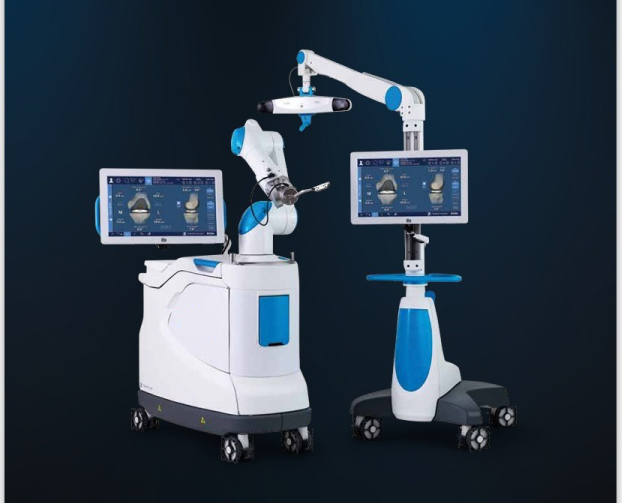
It is an advanced robotic technology that provides high-precision support to the surgeon in knee and hip replacement surgeries. It allows for planning tailored to the patient’s unique anatomy and supports the surgeon’s decisions with real-time data during the operation.
In hip replacement: A personalized surgical plan is created using preoperative X-ray images. The system provides instant feedback during surgery for implant positioning, leg length balance, and correct angle adjustments. This helps in achieving more accurate and reproducible results. Furthermore, its ability to operate without the need for a Computed Tomography (CT) scan and its easy integration into the surgical process are among its significant advantages.
In knee replacement: It assists in performing bone cuts and implant placement with millimetric accuracy during knee replacement surgeries. Soft tissue balance and joint range of motion are measured during the operation to implement an appropriate, personalized plan. Compared to conventional methods, this technology aims to provide precise alignment and predictable outcomes.
General advantages:
-
Personalized surgical planning
-
Guidance during surgery using real-time data
-
High accuracy and precision
-
Technology that enhances the surgeon’s control
-
More balanced and compatible prosthesis placement
Robotic systems, as one of the advanced technologies in modern orthopedic surgery, offer reliable and personalized treatment options in knee and hip replacement surgeries.


